Anti-Christian drums loud before attack
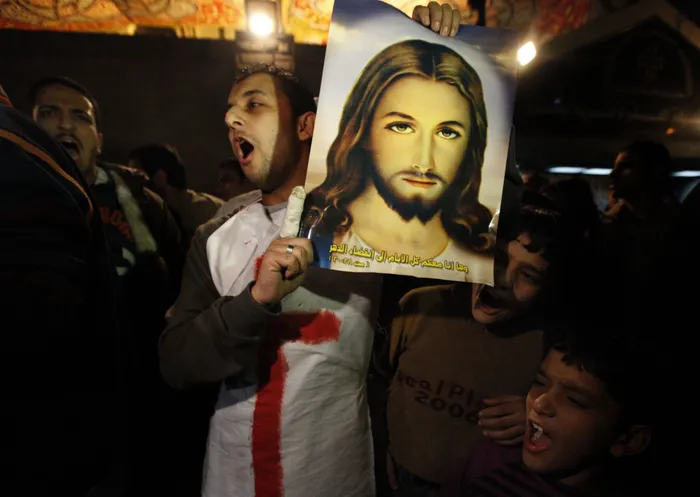
Angry Copts carry a picture of Jesus Christ and chant anti-government slogans during a protest before clashing with Egyptian riot police in Cairo after a New Year's Day church bombing that killed 21 people. Angry Copts carry a picture of Jesus Christ and chant anti-government slogans during a protest before clashing with Egyptian riot police in Cairo after a New Year's Day church bombing that killed 21 people.
Cairo, Egypt - In the weeks before the New Year's Day suicide bombing of an Egyptian church, al-Qaeda-linked websites were carrying a how-to manual on “destroying the cross,” complete with videos on how to build a bomb and the locations of churches to target - including the one that was attacked.
They may have found a receptive audience in Alexandria, where increasingly radicalised Islamic hard-liners have been holding weekly anti-Christian demonstrations, filled with venomous slogans against the minority community.
The blast, which struck on Saturday as worshippers were leaving midnight Mass at the Mediterranean city's Saints Church, killed 21 people.
President Hosni Mubarak has accused foreign groups of being behind the attack, which has sparked a wave of angry protests by Christians in Egypt.
But on the ground, investigators are searching in a different direction - scrutinising homegrown hard-liners, known as Salafis, and the possibility they were inspired by al-Qaeda to carry out the attack.
Only two or three days before Saturday's bombing, police arrested several Salafis spreading fliers in Alexandria calling for violence against Christians, a security official said. He spoke on condition of anonymity because he was not authorised to talk to the media.
According to authorities, the strong belief among investigators is that local extremists who knew the area and the nature of their target were behind the attack. The Egyptian weekly Al-Youm Al-Saba said police were examining photos of the Salafis' weekly protests for suspects linked to the bombing.
In the weeks before the attack, al-Qaeda militants on the Web spewing calls for “jihad,” or holy war, on Egypt's Christians laid out everything anybody would need to carry out a bombing.
One posting widely circulated on al-Qaeda-linked sites includes a so-called “Jihadi Encyclopedia for the Destruction of the Cross,” with a series of 10 videos describing how to build a bomb.
In the videos, an unidentified militant in a white lab coat and a black mask is shown listing the ingredients to make TNT and mixing up the chemicals in beakers.
It lists Coptic Christian churches in Egypt, along with phone numbers and addresses - including Alexandria's Saints Church.
“Blow up the churches while they are celebrating Christmas or any other time when the churches are packed,” it says.
Security officials say they were aware of the online “how-to manual” before the church bombing and are examining any links between it and the material posted on Islamic websites.
One main Salafi group, the Salafi Movement in Alexandria, issued a statement condemning the bombing, saying its preachings “reject such practices”.
The ultra-conservative Salafi ideology has been gaining followers throughout Egypt in recent years, preaching a return to the ways of early Muslims. It calls for strict segregation of the sexes and rejection of any religious “innovations,” such as permitting boys and girls to attend school together or collecting interest on bank loans.
The movement has spread across class lines, among wealthy businessmen, the middle class and urban poor. Men grow long beards and shave off moustaches, to imitate the Prophet Muhammad. Women wear the black niqab robes and veil, which envelop the entire body and face, showing only the eyes.
In many ways, it resembles the doctrine of al-Qaeda, with one major difference: while it advocates jihad against “foreign occupiers” in Iraq or Afghanistan, it rejects holy war inside Egypt, at least for now.
But many observers warn that some members of the movement are growing more radicalised and have begun to advocate violence within the country, providing fertile ground for al-Qaeda influence.
They cite the group's unprecedentedly fierce campaign against Egypt's Coptic Christian Church.
It was sparked by the case of two Christian women who reportedly converted to Islam to get divorces from their husbands, since divorce is banned by the church. The Salafis accuse church authorities of forcing the women to renounce Islam and return to Christianity, a claim the church denies.
At weekly protests attended by hundreds outside mosques in Alexandria and Cairo, Salafis have accused church authorities of holding the women against their will. Vowing vengeance and denouncing Coptic Pope Shenouda III as an “infidel,” the protesters accused Copts of trying to “Christianise” Egypt's Muslims and stockpiling weapons in churches and monasteries.
In September, one Salafi cleric, Ahmed Farid, wept as he told worshippers at an Alexandria mosque that Muslims were being “humiliated” by Christians, chiding them for “giving up jihad.”
At a Salafi protest in Cairo in October, some raised the flag of al-Qaeda in Iraq -a black banner emblazoned with the phrase “there is no god but God and Muhammad is God's prophet.”
Two days later, al-Qaeda in Iraq attacked a church in Baghdad in a siege that left 68 Christians dead, the worst attack yet against Iraq's Christian minority. The group issued a statement vowing a campaign against Christians unless the two women in Egypt were freed, and several other attacks on the community in Baghdad have followed.
Since then, calls on al-Qaeda-linked websites for attacks on Egypt's Christians have grown to fever pitch.
A statement posted with the videos decries the failure of Muslims to act to free the two women.
“Will we keep on dreaming and dreaming, or is it time to wake up to the echoing boom and the flying torn limbs that will please the faithful and scare the infidels?” the statement reads. “Of course, it is better to act as a group, but that must not be an impediment between you and action. Move forward on your own.”
The threats raise the question of why security officials did not do more to protect churches. On New Year's, the Saints Church had only three or four policemen outside and cars had easy access to the street.
Copts, who make up about 10 percent of Egypt's nearly 80 million people, accuse the government of ignoring threats against them and doing nothing about growing anti-Christian sentiment in Egypt.
Experts say the government has tacitly allowed the growth of Salafism because it is not anti-government and does not get involved in Egypt's politics, as opposed to the fundamentalist Muslim Brotherhood, which is the regime's main political rival.
Rifaat Sayyed Ahmed, an expert on Islamic groups, said: “The Egyptian regime is harvesting the sour fruits of letting this extremist thought grow and recruit thousands of young Egyptians.
“We have a generation of young men ready for martyrdom.” - Sapa-AP